 how-to
Automated Copy Trading for Gold: A How-To Guide
Table of Contents
- What Is Automated Copy Trading for Gold
- How Trade Mirroring Works in XAUUSD Copy Trading
- Choosing the Right Gold Trading Platforms
- Finding and Evaluating Gold Trading Signals
- Setting Up Your Account and Connecting Trades
- Managing Gold Copy Trading Risks
- Monitoring and Adjusting Your Copy Settings
- Frequently Asked Questions
Last Updated: October 21, 2026
What Is Automated Copy Trading for Gold
Automated copy trading for gold mirrors experienced traders' XAUUSD trades in real time. When a signal provider trades, your account copies the entry point, with sizing adjusted to your balance and risk tolerance.
It suits busy professionals who want gold exposure without hours of chart analysis: set your parameters once and automation handles execution around the clock.
Automation executes predetermined rules, not gut feeling, consistency that's why many investors choose copy trading over manual trading.
The key difference from other automated systems is accountability: you mirror real traders with verifiable track records, not a black-box algorithm, and can see exact trades, win rate, and drawdown history.
How Trade Mirroring Works in XAUUSD Copy Trading
Trade mirroring connects your MetaTrader 5 account to a copy trading platform receiving real-time signals. When the trader opens a gold position, the platform calculates your proportional size and executes within seconds.
Sizing adjusts automatically: if the provider trades 1 lot and your account is half their size, you receive 0.5 lots, so exposure matches your capital, not theirs.
Real-time execution matters because XAUUSD moves fast during data releases and geopolitical events. A delay can mean entering at 2,455 instead of 2,450, a gap that compounds across dozens of trades monthly.
The platform also mirrors stop-loss and take-profit levels proportionally, and exit signals trigger automatically across all copied positions.
A common mistake is assuming copy trading removes all risk. You're still exposed to drawdowns, slippage, and gaps, but from a trader with a documented track record, not your own emotional trading.
Choosing the Right Gold Trading Platforms
Not all copy trading platforms handle XAUUSD the same way. Some restrict gold trading, charge hidden per-trade fees, or execute through brokers with poor liquidity during volatile sessions.
The best platforms for gold copy trading meet these criteria:
- Support MetaTrader 5 connections directly (not third-party bridges)
- Display live performance data independently verified
- Offer adjustable copy ratios so you control position sizing
- Charge transparent fees without hidden spreads on gold trades
- Provide 24/5 execution during forex market hours
Check whether the platform lets you copy specific traders rather than forcing you into a fund, so you can test one strategy first.
Verify execution speed too: during US data and Fed announcements, a one-second delay can mean 10+ pips of slippage. Ask for average execution time in milliseconds.
Finding and Evaluating Gold Trading Signals
The trader you copy matters more than the platform: a mediocre platform with an excellent trader beats an excellent platform with a mediocre one.
Filter for traders who specialize in XAUUSD with at least 6 months of verified gold trading history, not just general forex.
Look beyond win rate: 70% means little if the trader takes 10-pip profits and 50-pip losses. Average profit per trade matters more than the percentage of winners.
Key metrics to examine:
- Consecutive winning months: Six months is solid; 12+ is exceptional. Gold trading has seasonal patterns and geopolitical shocks, so a trader profitable through multiple cycles has proven adaptability.
- Maximum drawdown: What's the largest peak-to-trough decline in the account? Less than 5% is conservative; 10-15% is acceptable for gold trading; above 20% suggests the trader takes excessive risk.
- Recovery time: How many months to reach new highs after a drawdown? Quick recovery suggests the trader adjusts strategy; slow recovery suggests passive waiting for favorable conditions.
- Trade frequency: 20-40 trades per month is typical for trend-following. Fewer than 10 suggests selectivity; more than 60 suggests scalping, which carries higher slippage costs.
Verify statistics independently: check whether the trader's account is verified on MyFXBook or a similar third-party service, confirming the numbers aren't fabricated.
Setting Up Your Account and Connecting Trades
Setting up automated copy trading for gold is a sequence: broker first, platform second, provider third, sizing last. That order prevents discovering too late that your broker restricts XAUUSD or minimum lot sizes make proportional copying impossible.
Step 1, Choose a broker that permits copy-trading connections. Open a MetaTrader 5 account with a broker that explicitly allows third-party copy-trading platforms to place orders.
Step 2, Fund with a test allocation, not your full budget. Fund enough to meet the platform minimum and keep copied positions above the broker's minimum lot size.
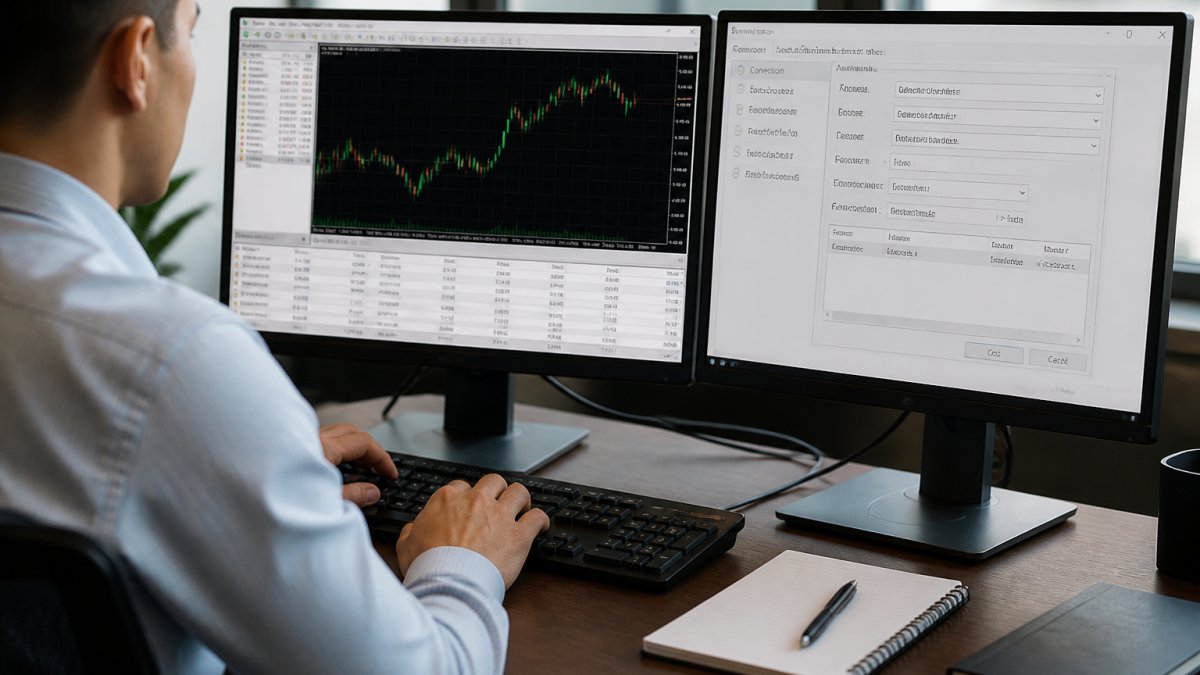
Step 3, Connect the account to the copy platform. Most platforms link to MetaTrader 5 via broker-side permissions or an investor/API credential from the broker's client area. Copy it exactly, one mistyped character breaks the link.
Step 4, Configure copy settings with the math in front of you. Most beginners go wrong here, because "copy ratio" is not the same as "risk per trade." An illustrative example:
- Provider account equity: $50,000. Your account equity: $5,000. Your account is one-tenth the size.
- Provider opens 1.00 lot of XAUUSD. A proportional 0.1 ratio would give you 0.10 lots, but only if your broker's minimum is 0.01 and the platform supports fractional sizing.
- If the provider instead opens 0.20 lots, a 0.1 ratio gives you 0.02 lots. If your broker's minimum is 0.10, the platform cannot place 0.02, it may skip the trade or round up to 0.10, which is five times your intended exposure. Rounding up is the silent risk multiplier in small-account gold copying.
Two settings control this: the copy ratio (fixed multiplier or proportional-to-equity) and the maximum lot cap per copied trade.
Also decide how the platform handles the provider's stop-loss and take-profit. Most mirror them proportionally; some let you override with a fixed stop.
Step 5, Test before scaling. Enable copying at the smallest ratio allowed, run several trades including one in a volatile session, and compare your fills to the provider's.
Managing Gold Copy Trading Risks
Gold is not a quiet instrument, and copy trading does not change that. XAUUSD can move tens of dollars in minutes around US inflation data, Fed decisions, and geopolitical headlines, and it can gap over the weekend.
Volatility around scheduled events. Gold reacts sharply to US CPI, non-farm payrolls, Fed statements, and central-bank decisions. A provider who holds through these releases exposes your copied account to the same spike.
Overnight and weekend gaps. Gold trades nearly around the clock on weekdays but closes over the weekend. A gap at the weekly open can jump past a stop-loss, filling at a worse price.
Leverage magnifies everything. Gold's contract size and point value mean a small price move produces a large account swing at high leverage. A $10 move on 0.10 lots is about $100, meaningful on a small account.
Stop-loss behavior in copied trades. Your copied stop mirrors the provider's, but execution can differ: during fast moves, your stop may fill with slippage.
Correlated exposure. Copying two or three gold providers does not diversify if all trade XAUUSD in the same direction at the same time. During a strong trend or risk-off move, correlated providers lose together.
Costs that erode copied results. Spreads on gold widen around news and at market open, and swaps apply to overnight positions. A strategy profitable on gross returns can turn marginal after spread, commission, swap, and copy-provider fees.
A practical risk framework:
- Set a maximum account loss in dollars and a maximum drawdown percentage; stop copying when either is hit.
- Cap lot size per copied trade and keep total gold exposure within a level a weekend gap cannot wipe out.
- Reduce or pause copying around major scheduled economic releases if your provider holds through them.
- Review correlation across providers monthly and cut overlap.
- Track slippage and total costs, not just win rate, when judging whether copying is working.
Monitoring and Adjusting Your Copy Settings
After setup, your job shifts from execution to monitoring performance and adjusting settings.
Check your account weekly: trades copied, win rate, and unusual slippage. If slippage consistently exceeds 5 pips, your broker may have poor gold liquidity, consider switching.
If the provider is profitable but your account isn't, slippage or fees are often eating profits. Test reducing your copy ratio by 20%; if profitability improves, execution costs, not the strategy, were the problem.
Some traders reduce their copy ratio before high-volatility periods like US election cycles, Fed rate decisions, and geopolitical tensions.
If the provider's drawdown exceeds your tolerance, pause copying but let existing trades play out. Resume once the provider reaches new highs.
The most common mistake is abandoning a strategy too early. A profitable trader will have losing months; stop after month one of a drawdown and you miss the recovery in months two and three.
Automated copy trading for gold offers a structured way into XAUUSD markets without manual trading's time commitment. The key is a verified signal provider, realistic risk parameters, and consistent monitoring of execution.
SonicAi Gold's approach focuses on 18+ consecutive winning months and independently verified performance on MyFXBook. The low drawdown ensures capital preservation alongside returns.
Start with a small copy ratio, verify the setup works for 2-4 weeks, then scale gradually. This methodical approach beats rushing into full-size positions based on impressive headlines.
Frequently Asked Questions
How does automated copy trading for gold actually work?
Automated copy trading mirrors trades from a verified signal provider directly into your MetaTrader 5 account in real-time. When the provider executes a trade on XAUUSD, your account automatically places an identical or proportionally-sized trade based on your copy ratio and account allocation. The system handles order placement, position sizing, and exit signals without manual intervention, allowing you to benefit from the trader's strategy while you focus on other priorities.
What makes a gold trading signal provider trustworthy?
Look for independent verification of live trading performance through platforms like MyFXBook, which shows real account statements and audited results. Evaluate win rate, drawdown history, and consistency across multiple market conditions, not just headline returns. A provider with 18+ consecutive winning months and verified low drawdown (under 1%) demonstrates resilience through volatile gold sessions. Check how long they've been trading live, and if their performance is audited by a third party.
What are the main risks in gold copy trading, and how do I control them?
Gold volatility can trigger rapid drawdowns if copy settings are too aggressive. Control risk by setting position-sizing limits (copy ratio), using stop-loss and take-profit levels, and allocating only capital you can afford to lose. Monitor drawdown thresholds and avoid copying during extreme market events without understanding the trader's risk controls. Test with a small account first, track slippage and spread costs, and be ready to pause copying if the strategy diverges from its historical performance.
Is copy trading for gold legitimate, or just another trading bot scam?
Copy trading is a legitimate strategy when the signal provider has independently verified performance. However, not all systems are equal. Avoid providers making unrealistic guarantees or hiding their track record. Legitimate services like those verified on MyFXBook show real results, disclose fees transparently, and allow you to control risk settings. Gold trading itself carries real market risk, no strategy eliminates losses, but verified automation with proper risk controls is a credible approach for busy professionals seeking passive exposure.